The Back of a Police Van:
Echoes of Biko in Modern South Africa
The measure of a democracy is not how it treats its most popular figures, but how it treats its most controversial ones. While many may find the politics of Fadiel Adams rooted in identity-based nationalism to be divisive, the critique of his ideology has recently been overshadowed by a far more urgent crisis: the weaponization of the state against a sitting Member of Parliament.
When the process itself becomes the punishment, the shadow of our past grows long. The facts of Adams’s recent detention are stark. Arrested at his Cape Town home, he was transported 1,600 kilometers to KwaZulu-Natal in the back of a police van. The thirty hour journey took place in biting cold; Adams wore only a light jacket. Upon arrival, he was held at an undisclosed location, with the state opposing bail for an offense allegedly relating to a prison visit.
The context cannot be ignored. Adams has built a reputation as a fierce adversary of police corruption, becoming a trusted conduit for whistleblowers who feel unsafe going through standard channels. He has previously exposed classified envelopes left in his office and openly accused senior SAPS generals of criminality. Yet, while his efforts have cast a harsh spotlight on systemic corruption within the top brass, the disparity in treatment is telling: a senior police general facing separate, serious charges was recently granted bail and international travel privileges within hours. For Adams, the presumption of innocence was abandoned in favor of procedural degradation.
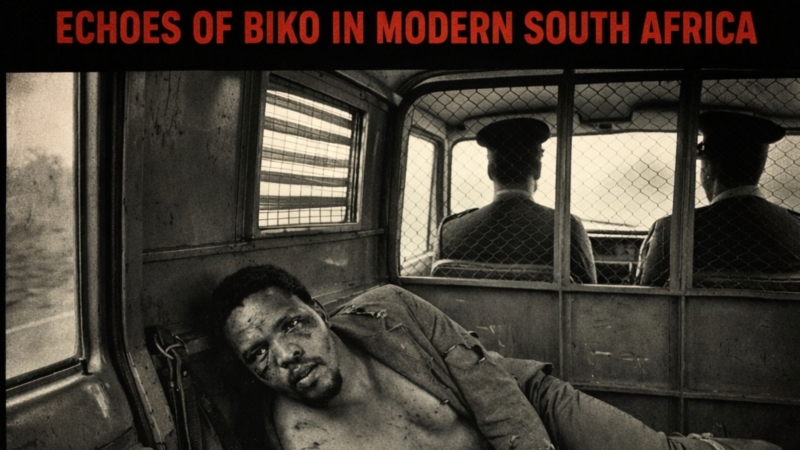
To understand the gravity of this moment, we must look to the history written in the back of police vans. In September 1977, the apartheid state sought to silence Steve Biko not because he was a criminal, but because he was an organizer who dared to demand dignity for the marginalized. Biko was stripped, beaten, and driven from Port Elizabeth to Pretoria in the back of a van. He was pronounced dead on arrival.
The parallel between Biko and Adams does not lie in their specific ideologies, Black Consciousness and Coloured Consciousness are distinct frameworks. Rather, the resemblance between Steve Biko and Fadiel Adams is found in their shared, unwavering disdain for imposed authority. Both men demonstrated a refusal to be coerced into submission choosing instead to stand their ground against a state that expects deference.
Like Biko, Adams’s political project focuses on the restoration of self-respect among the oppressed. It is this refusal to accept the status of a "lesser being" that makes such leaders inherently dangerous to those who hold power.
A Rare Form of Leadership
In a political landscape often defined by silence and complicity, Adams’s willingness to sacrifice his own comfort and freedom is a rarity.
While his rhetoric remains controversial, his courage is objective. In a country where whistleblowers are frequently silenced or murdered, he persisted in his critique of the powerful until the police van arrived at his door.
If we allow his treatment to be dismissed because we find his identity politics uncomfortable, we betray the very foundation of our constitutional order.
The Threat to the Republic
This is not merely a story about one politician; it is a warning about the fragility of our democracy. When a police official can trigger the humiliation and prolonged detention of a critic, the law ceases to be a shield and becomes a weapon for the connected.
Democracy relies on the principle that no one is above the law but equally, that no one is beneath its protection. To treat a critic as a legitimate target for state-sponsored "examples" is to admit that we have learned nothing from the brutalization of activists under apartheid.
The silence from most media and parliament itself regarding this overreach is the most damning indictment of our current climate. Principles are only meaningful if they are applied to those we dislike. Neutrality in the face of procedural abuse is, in fact, an endorsement of state overreach.
We must defend the principle, even if we do not embrace the person. Steve Biko was broken in a van to silence a movement; today, the methods may be less lethal, but the impulse remains to break those who refuse to be silent. If we look away now, we prove that the brutal lessons of our history have been forgotten.
An opinion piece written by Imraahn Mukaddam (in his personal capacity)